

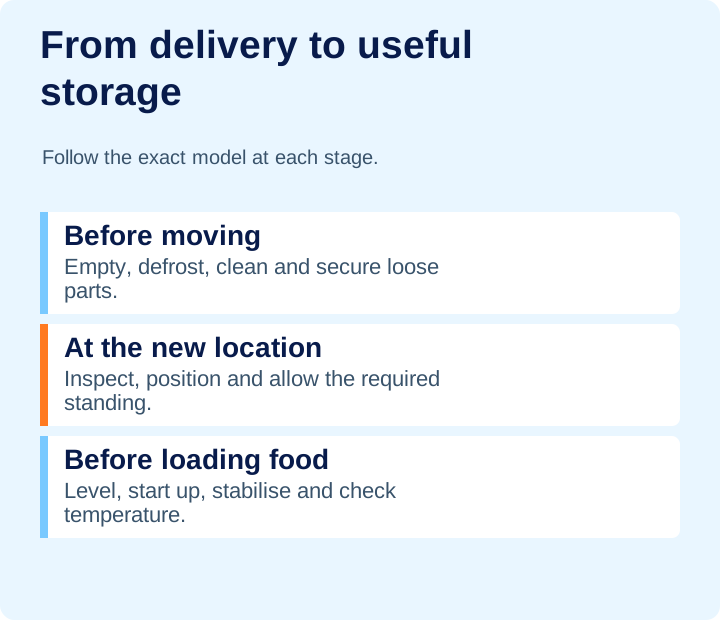
Before the move
Find the exact model label and its transport instructions before you disconnect anything. Plan food relocation, defrosting and cleaning so the appliance can be moved dry and empty. Keep the manual accessible during the move.
Remove or secure shelves and other loose parts using the approved method. Protect the door and cabinet without relying on the handle as a lifting point. Use the actual weight and route to arrange suitable help and equipment. A compact cabinet is not proof that one person can carry it safely.
Measure doorways, lifts, stairs and turns. For a new boxed appliance, use the packaged dimensions and shipping weight from the seller. Those values are separate from the installed cabinet dimensions used for placement.
Evidence and source notes ↗Transport orientation and handling
Use the manufacturer’s specified orientation and handling procedure. If a unit has travelled in an unknown position, obtain the model-specific guidance before restarting. Do not assume that advice for a similar refrigerator applies.
Protect the power cord and avoid stressing refrigerant lines or other vulnerable components. Keep the appliance secure during transport. If it arrives damaged, document the visible problem and use the seller’s delivery or return procedure.
An appliance that appears intact still needs the required standing and setup steps. A delivery driver’s generic recommendation does not replace the instructions for the exact model and transport conditions.
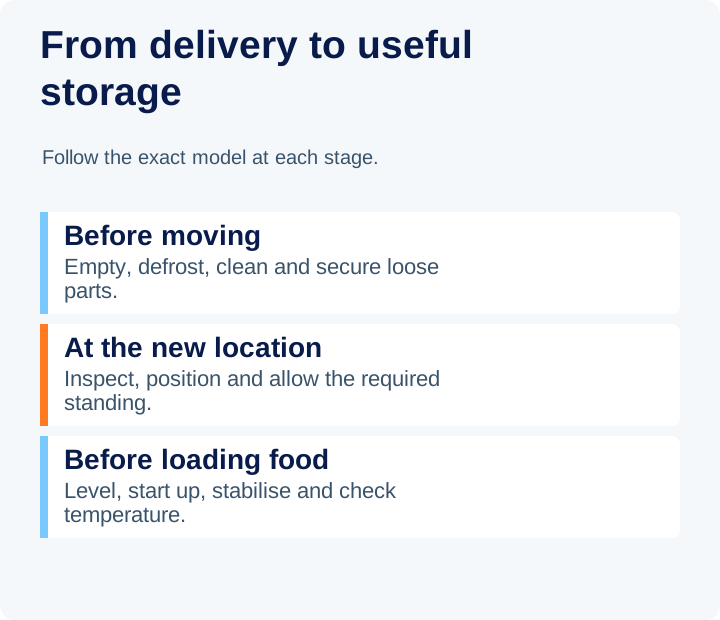
Prepare the final position
Choose the intended floor position and check the manufacturer’s requirements for level support, ventilation and operating environment. Add the side, back and top gaps to the cabinet measurements. Check door swing and access to removable interior parts.
Use the electrical supply and connection specified in the manual. Do not infer suitability for an extension lead, power strip, inverter or other arrangement from the fact that the fridge is small. If the supply is unsuitable or uncertain, resolve it before connecting the appliance.
Check that nearby furniture or stored items will not gradually block the airflow. The clearance guide has a worksheet for keeping cabinet, ventilation and open-door measurements separate.
Evidence and source notes ↗Standing, levelling and first start
Follow the required standing period and levelling procedure for the exact model. Different instructions and transport circumstances can call for different waiting periods; this article intentionally does not assign one universal number.
Clean the interior if the instructions call for it, fit the shelves correctly and choose the recommended starting control setting. Allow the specified cooling or stabilisation period before relying on the fridge.
Verify actual temperatures with an appliance thermometer. FDA guidance calls for 40°F or below for refrigerated food and 0°F or below for frozen food. Check that the compartment is intended for the frozen-storage use you have in mind.
Evidence and source notes ↗Keep a simple delivery record
Keep the receipt, seller details, full model and serial label, delivery condition and any transport information. Note which instructions you followed before start-up. These details make a support conversation or return request more precise.
If the appliance cannot reach suitable temperatures, the door does not seal, or there is evidence of damage, use the manufacturer or seller’s process. Avoid dismantling the appliance to diagnose a delivery issue.
Before an end-of-term move or long storage period, repeat the food relocation, cleaning and drying steps. Follow the manufacturer’s storage instructions and make sure the appliance cannot become an unintended access or entrapment hazard.
Check the appliance at handover, not just the box
Compare the model and finish on the delivered unit with the order. Photograph visible packaging or cabinet damage before discarding the packaging, and follow the seller’s reporting process. Check that shelves, drawers and any confirmed keys or loose accessories are present. Keep the serial label legible for support.
Cabinet dimensions are not packaged dimensions, and net weight is not shipping weight. For example, Whynter lists 61 lb net and 77.25 lb gross for BR-1211DS. Use the relevant handling figure and suitable help for the actual delivery; do not assume a mini fridge is safe for one person to carry. Follow the supplied transport and start-up instructions before loading it.
Questions before you choose
Do I always need to wait 24 hours?
No universal waiting time is established here. Follow the exact model’s standing instructions and account for how it was transported. Ask the manufacturer if the transport history is unclear.
Can I transport a mini fridge on its side?
Use the permitted orientation for the exact appliance. Do not infer permission from advice for another model. If it has already travelled in an uncertain position, obtain model-specific restart guidance.
Can I put food in as soon as it turns on?
Wait for the instructed start-up and stabilisation process, then verify the storage temperature. Power and lighting alone do not show that food can be stored safely.